DRIFT’s Aeolus uses glass rods and visitor responsive light to make a fixed, architecture shaped sculpture suggest the movement of air.
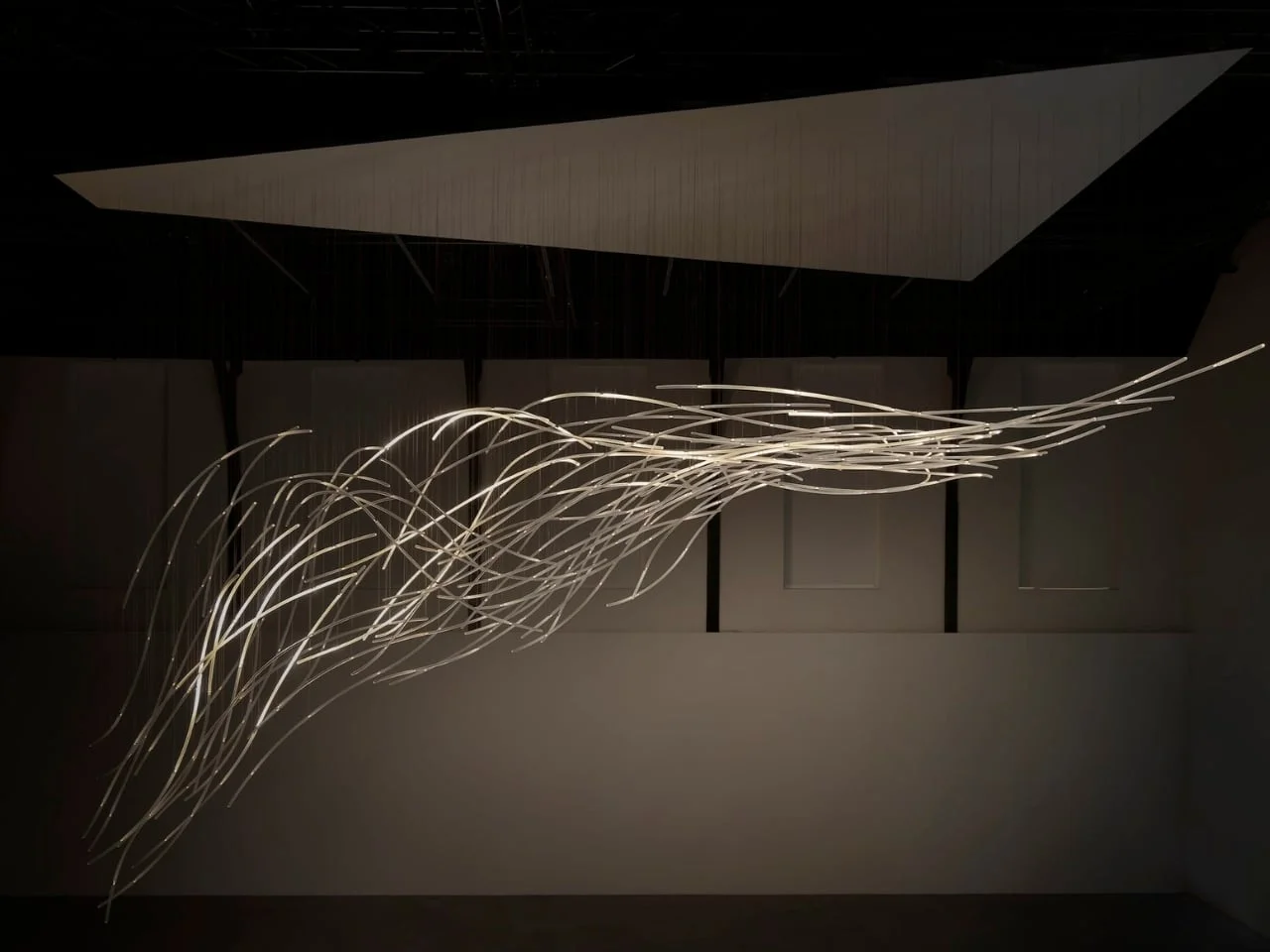
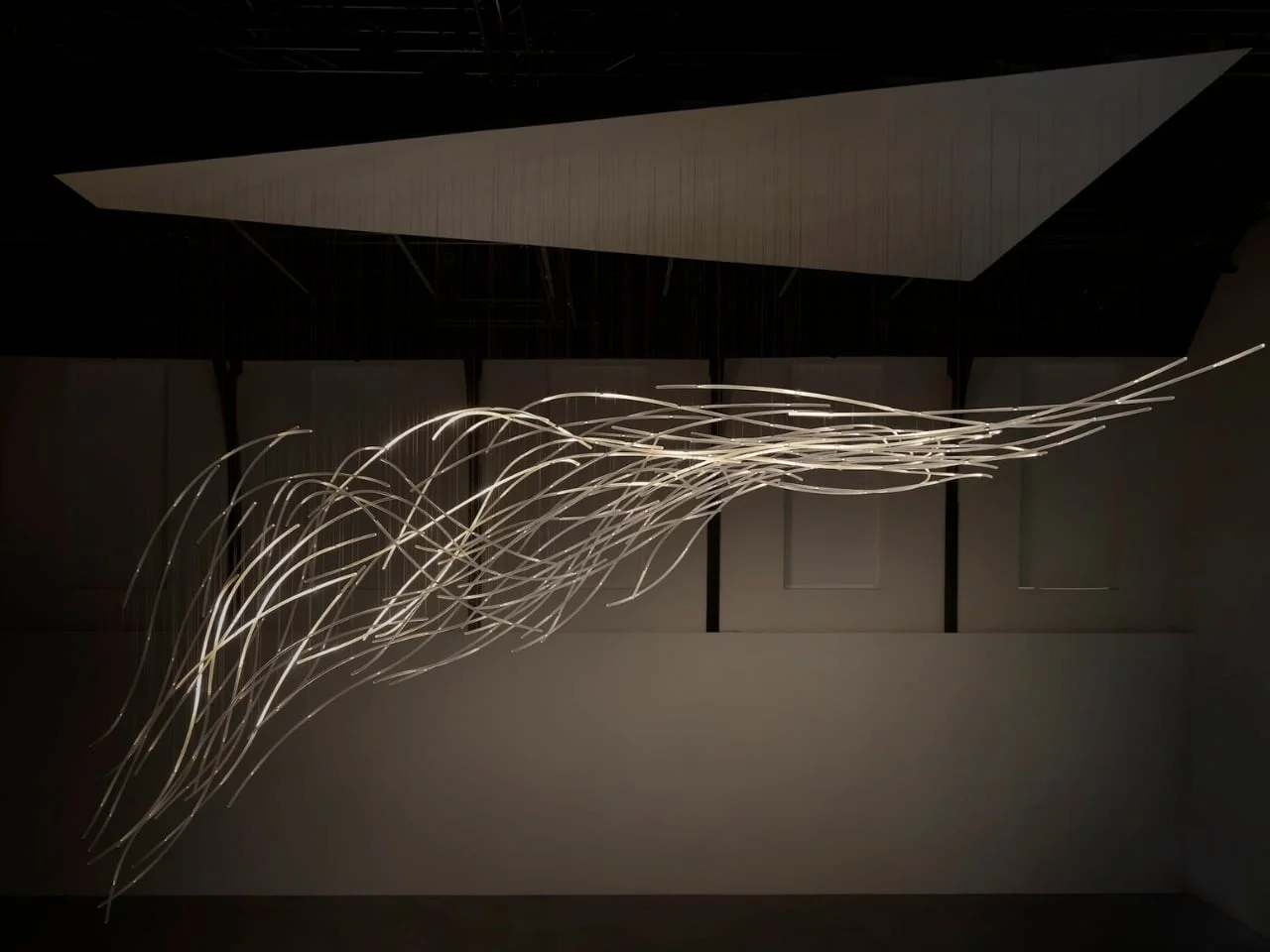
DRIFT’s Aeolus makes airflow visible by freezing its shape in glass and letting light supply the motion. The Amsterdam studio’s installation, shown with Carpenters at London’s Ladbroke Hall from October 13 to 25, 2026, is built from hundreds of suspended rods. Visitors walking through the space change the lights’ rhythm and intensity, creating waves across a sculpture that never physically moves. The premise is easy to grasp at a glance, but the effect depends on a more delicate exchange: a stable object gives changing light somewhere to travel, while the visitor’s presence alters how that object appears.
That separation between fixed form and shifting light is the work’s strongest idea. Wind can be difficult to observe directly; Aeolus gives the eye a structure to follow while keeping the glass still. The installation takes its name from the Greek god of the winds, but its form begins with a more immediate source: the architecture around it. The result isn’t a literal portrait of a gust. It’s a translation, with the building shaping the lines and light giving those lines a second life in the room.
Designer: DRIFT
A sculpture shaped by its setting
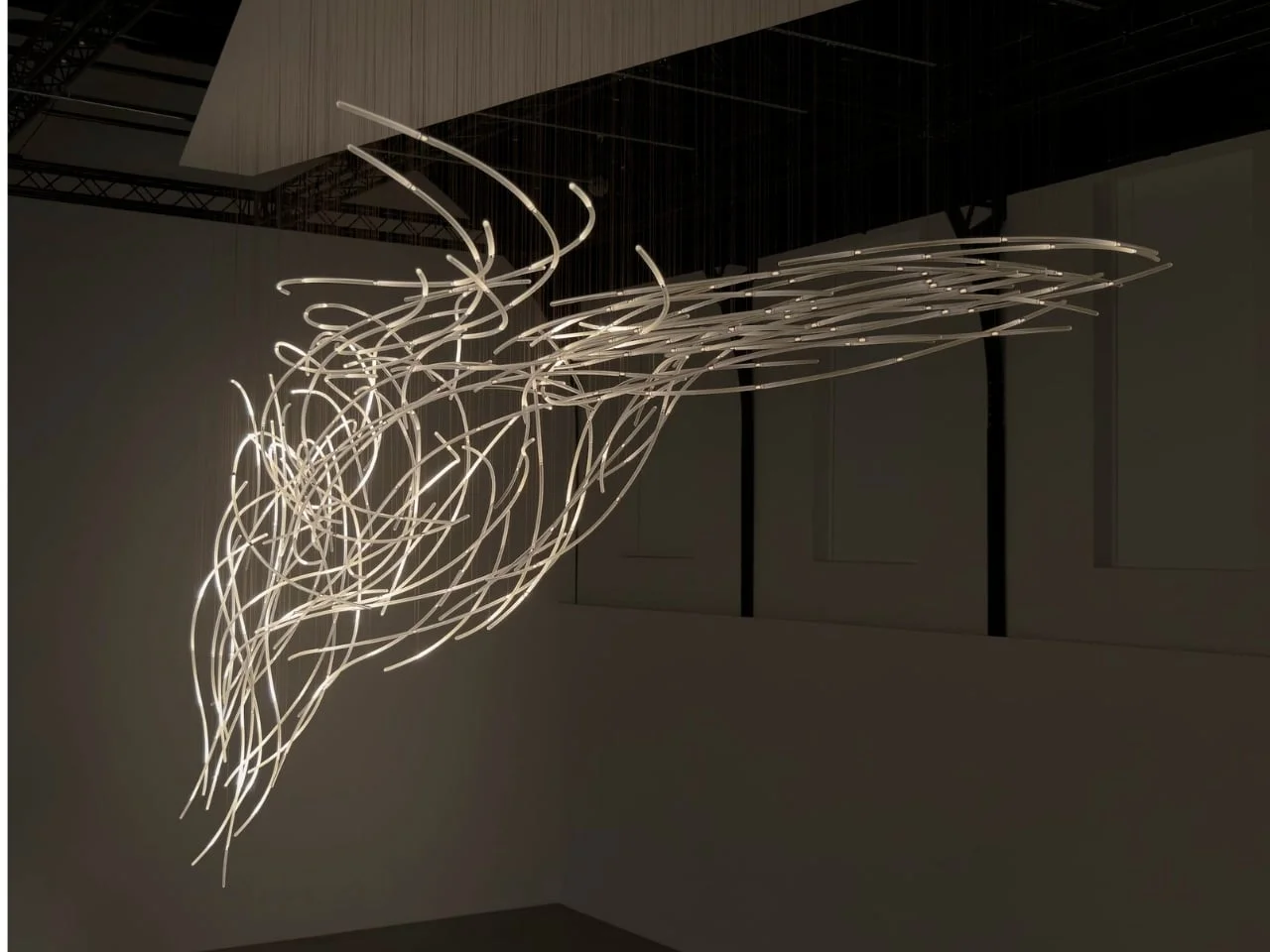
DRIFT first creates a digital reading of the host space, then builds a virtual environment in which air can flow through it. From that simulation, the studio selects a single moment and translates its contours into glass. Aeolus therefore records an imagined path of air shaped by a particular room; it doesn’t respond to a live measurement of the gallery’s breeze. That distinction matters: the work uses simulation to make a form, then presents the form as a lasting object rather than a real time weather display.
That process gives the building a real role in the artwork. Rather than placing a finished form into an empty setting, DRIFT generates each installation from its host architecture. Visitors may never see the underlying model, but the curves they encounter carry the imprint of that place. The room isn’t just a backdrop, then. Its geometry helps determine what the sculpture can become, even if that relationship is more legible in the concept than in any single view of the rods.
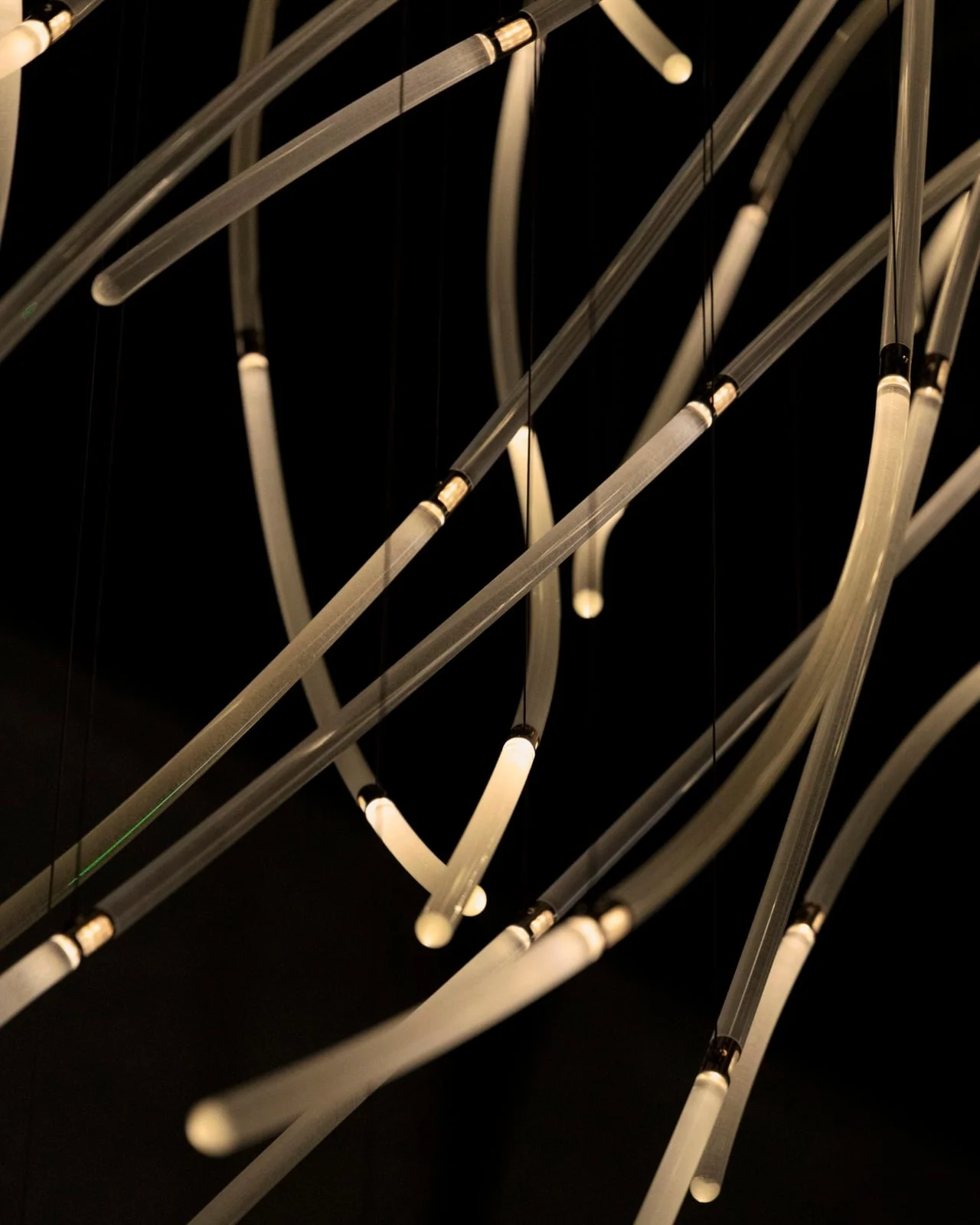
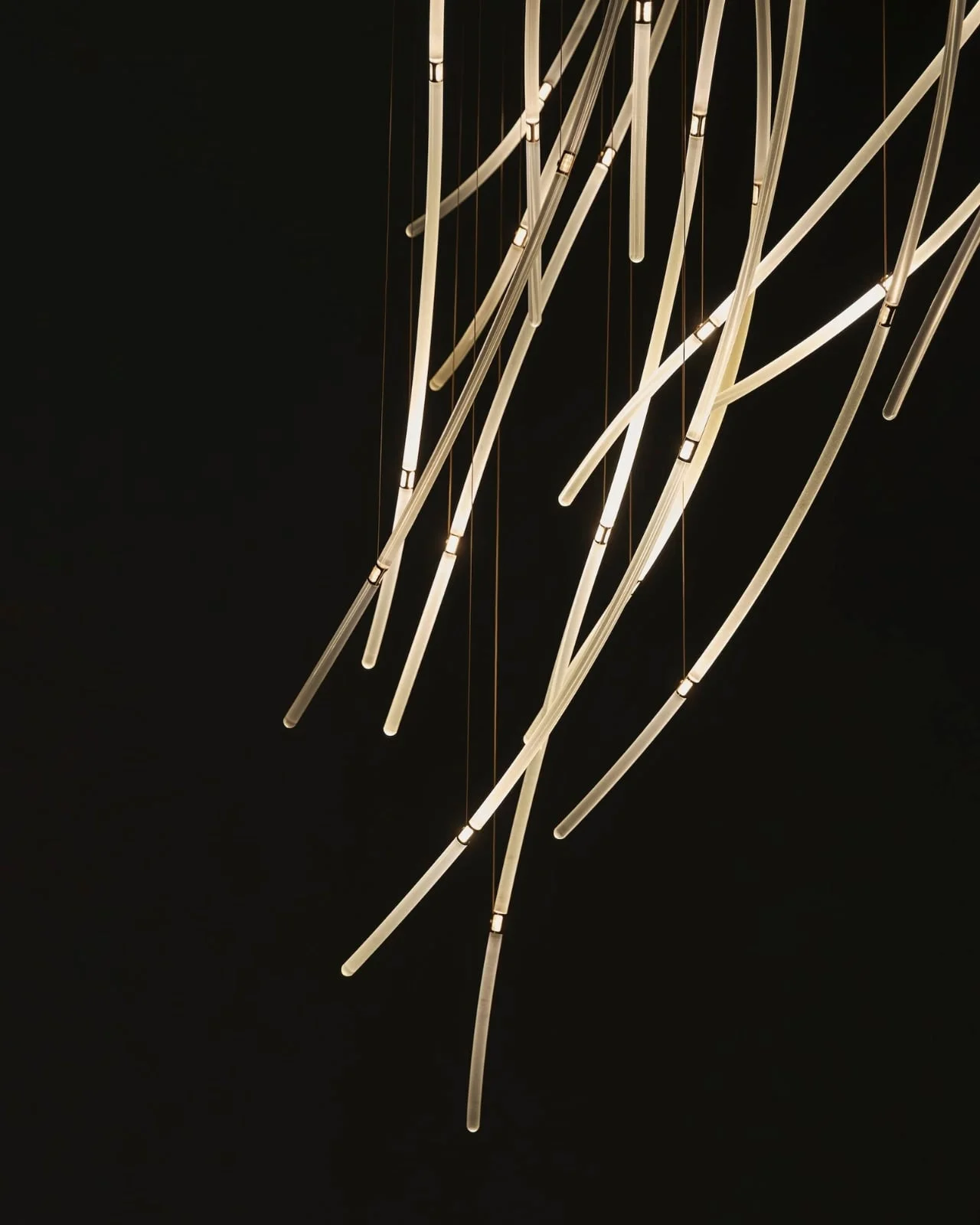
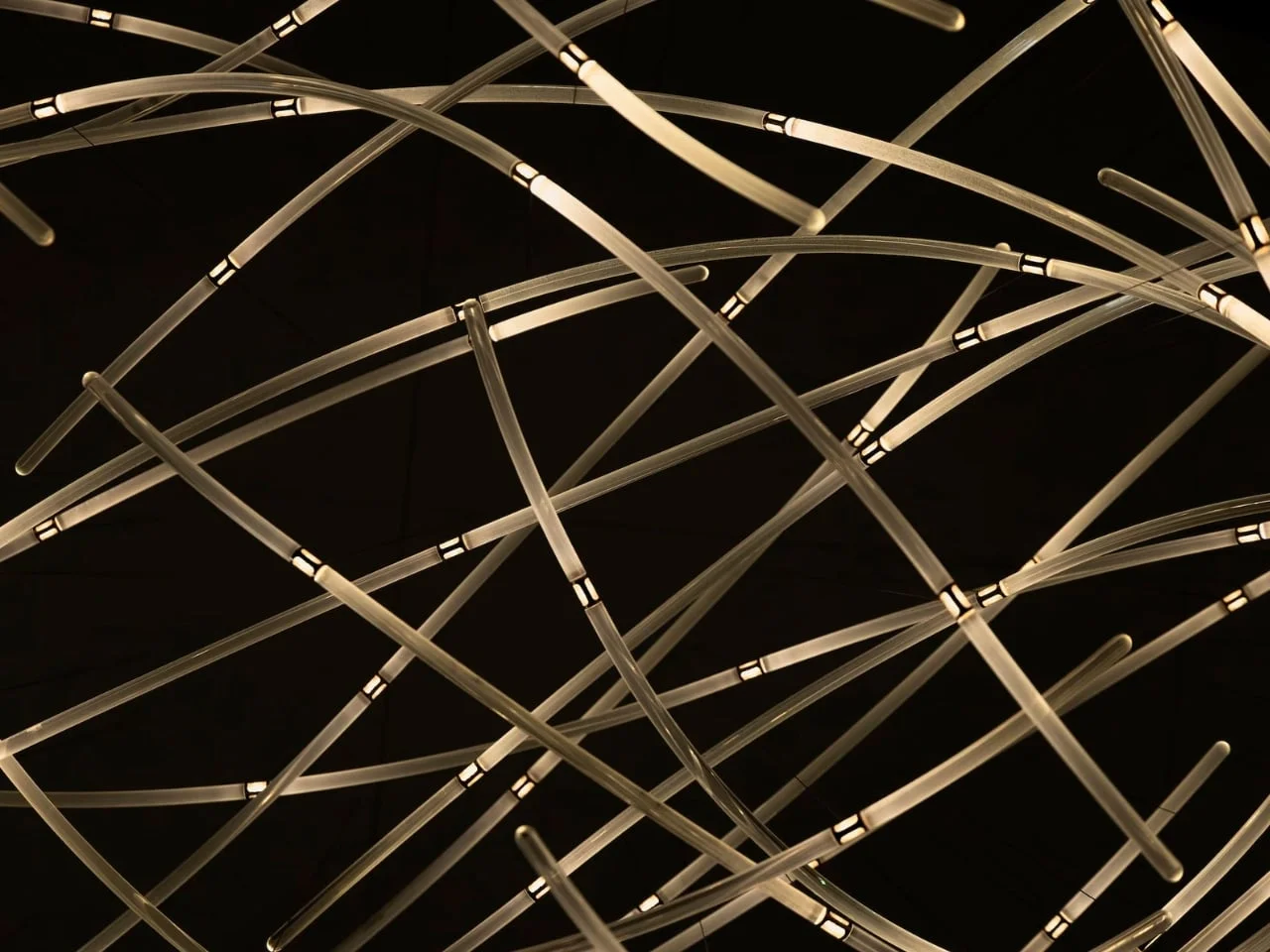
Photographs by Benjamin Baccarani show the rods sweeping across the space, dipping at one end before extending outward. Fine suspension lines connect the formation to a wide overhead panel. The materials include borosilicate glass rods, stainless steel nodes, custom LEDs and microcoax cables. The effect may look weightless, but its construction depends on careful support and a network of physical connections. That contrast is part of the piece’s appeal: the apparent flow is held in place by a quite tangible assembly of glass, metal and wiring.
Light makes the stillness feel active
Carpenters says small lights inside the rods alter their rhythm and intensity as visitors move nearby. The resulting pulses travel through the glass, suggesting motion without swinging or shifting the structure. That’s a clear design decision: the work uses light and perception to evoke wind, instead of relying on mechanical movement. The effect asks viewers to complete the illusion for themselves, reading a change in brightness as a change in force or direction.
Visitors affect what they see simply by walking through the room. The interaction doesn’t ask them to operate a control or learn a system; their movement changes the lighting. It gives the installation an immediate response that fits its subject, while keeping attention on the relationship between the body, the room and the sculpture. There’s a practical advantage to that simplicity: people can encounter the work without instructions, and their presence becomes part of the viewing experience almost at once.
What the installation makes visible
DRIFT presents Aeolus as an invitation to reconsider how people relate to nature. The more grounded achievement is its way of making airflow legible through material and light. The work doesn’t need to promise a change in visitors’ environmental outlook; it gives them a precise form to examine and a direct way to alter its appearance. That restraint is welcome. An artwork can prompt attention without claiming that attention will automatically lead to a broader shift in behavior.
Here’s the thing: air is difficult to study with the eye because it rarely holds a shape for long. Aeolus turns a simulated moment into a lasting arrangement, then lets visitors bring a different rhythm to it through light. The architecture informs the curves, the glass preserves them, and each person’s movement changes how they read. What began as a room around a sculpture becomes part of the sculpture’s story. This is more significant than it looks: the installation makes its setting and its audience active ingredients, not just conditions around a finished object.
A model for site specific work?
Aeolus points toward a useful possibility for installations designed around particular rooms. Digital simulation can help an artist interpret a space, while physical materials give that interpretation presence and duration. But the approach also sets a clear limit: the displayed form comes from a selected simulated moment, so viewers shouldn’t mistake it for a direct record of air moving in the gallery. That gap between model and observation is where the work’s central idea sits.
If you’re working in this space, the interesting question is how much of the experience depends on the specific architecture and how much comes from the interaction between light and people. DRIFT’s process makes the first part explicit, while the visitor response makes the second visible. And yet, the installation’s strongest measure may be simpler: does the room feel different once you’ve watched light travel through a shape that cannot move? A quiet shift in perception. (And this is the part most people overlook.) The materials do not merely depict wind; they make viewers notice how much of motion is something the eye infers.
The post DRIFT’s Glass Sculpture Traces Wind Without Moving first appeared on Yanko Design.

Discussion
Sign in to join the discussion.