BeBeau Builds has crafted a slate guitar that surprisingly performs well, merging creativity with engineering despite its hefty weight.
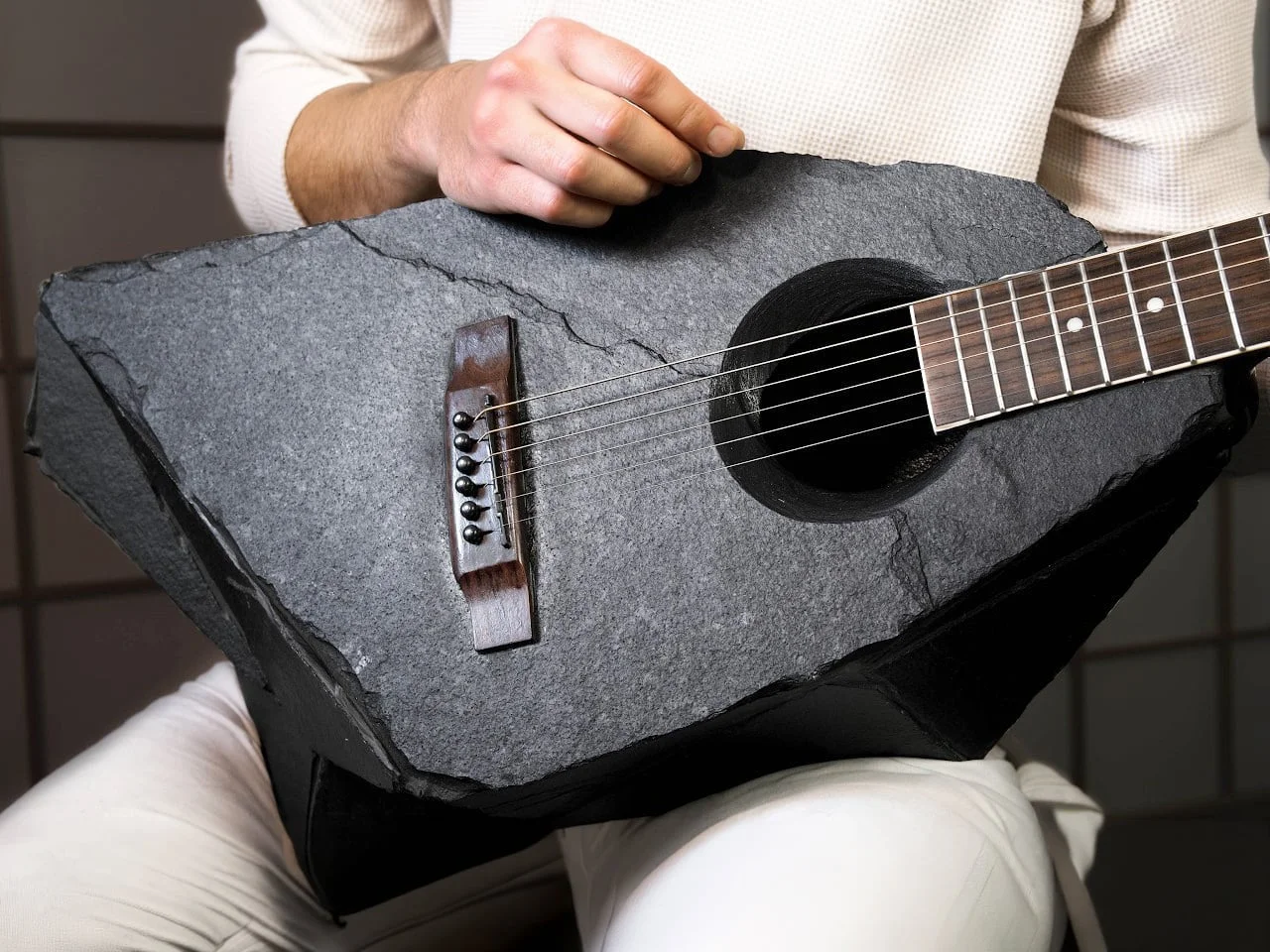
A fresh take on instrument design has emerged as BeBeau Builds has successfully created a guitar from slate stone, delivering both humor and craftsmanship. Tired of the discrepancy between the term “rock guitar” and its wooden reality, the YouTuber utilized a discarded acoustic guitar’s neck and fretboard while constructing the body from slate pieces. What results is a strikingly unconventional instrument that, against all odds, manages to produce music.
Construction Challenges and Solutions
The body required a meticulous assembly of eighteen individual slate slabs, intricately cut and adhered to a sturdy internal armature. Given the weight—almost 49 pounds—this guitar is far heavier than the average acoustic, reminiscent more of a car battery than a traditional instrument. The journey began with a tile saw, which overheated quickly on the dense material, necessitating the use of 3D-printed templates for precision. This shows a common issue in DIY projects: the unexpected need for specialized tools can derail the timeline and shift project requirements. Despite the ingenuity of the design, varying thicknesses across slabs led to alignment challenges. Thoughtful adjustments were crucial, showing that flexibility in problem-solving can be just as valuable as the original plan.
Material Properties and Sound Quality
Slate's natural properties made it a suitable choice, given its historical use for roofing and billiards. Yet, working with such a dense material posed significant challenges. The initial glue application failed, forcing the builder to meticulously strip components and restart the project. That might frustrate most DIY-ers, but it’s a more common occurrence than one might think in ambitious builds. In a clever twist, BeBeau employed hot glue temporarily while waiting for construction adhesive to fully cure. Surprisingly, when a piece of the soundboard cracked, using a backup slab resulted in even richer tones than the original. This incident underscores the unpredictable nature of acoustics; sometimes, the flaws in a plan can lead to unexpectedly pleasing results.
A Surprising Acoustic Performance
What’s perhaps most astonishing is the sound quality. When strummed unplugged, this slate guitar emits a surprisingly wooden tone, albeit with reduced volume and sustain. While this contrasts significantly with steel-bodied resonators, which can drastically alter an instrument’s tone at much lighter weights, there's more at stake. The sound quality raises intriguing questions about material influence in guitar creation. If you're working in this space, consider how different materials can affect not only tonal quality but also playability. Although there's an evident trade-off—no one's likely to replace their wooden guitar for a slate behemoth—the exploration itself is what many luthiers find fascinating. This endeavor reminds us that the conversation around sound isn't merely about tradition; it involves constant experimentation.
Pushing Boundaries in Guitar Design
This project aligns with trends where luthiers test the limits of traditional materials. Other unconventional builds have included instruments made from cardboard, LEGO bricks, and even coffee beans. BeBeau’s slate guitar enters this creative dialogue not merely as a novelty but as a functional instrument. It contrasts with typical instrument-making, which usually leans on tried-and-true materials—typically woods like mahogany or spruce. However, it still requires further evaluation from trained players to assess its tonal capabilities fully. This is where the slate guitar could fall short; without rigorous testing, its actual performance in a practical setting remains somewhat uncertain.
The Implications of Unorthodox Choices
BeBeau's slate guitar isn't just about humor or novelty; it's a commentary on the evolving definition of what a musical instrument can be. Such projects force us to reconsider not only instrument design but also the role of innovation in music. The creativity displayed here posits that artistry in lutherie might grow more expansive, moving beyond convention. And yet, within this realm of exploration, a cornerstone of lutherie—the intended sound—remains critical. What this means for you, if you're involved in instrument creation, is clear: consider how pushing design boundaries could lead to new sounds, possibly capturing audiences looking for something fresh.
At the end of the day, the slate guitar isn't just a clever dad joke; it demonstrates a blend of artistry and engineering that pushes the envelope of instrument design. This project showcases how wild creativity can yield practical results, albeit with some caveats. As these kinds of builds gain traction, expect to see more musicians and luthiers experimenting with materials, blurring the lines between art and instrumentality.
Discussion
Sign in to join the discussion.